
There isn’t one safe way to clean every rug. Wool, jute, synthetic, and washable rugs can respond very differently to water, chemicals, and agitation, so the first step is identifying what you’re dealing with, not picking a cleaning method.
For a lightly soiled rug, vacuuming and spot treatment is usually enough. A heavily soiled rug needs pre-treatment, agitation, and extraction. Delicate or valuable rugs are often better left to a specialist.
Before Cleaning a Rug, Identify Its Material
Check the care label first. Fibre, backing, and construction all affect how a rug reacts to moisture, chemicals, heat, and agitation.
| Rug type | General cleaning consideration | Main caution |
| Wool | Controlled, fibre-appropriate cleaning | Excess moisture, heat and unsuitable chemistry |
| Jute | Careful moisture-controlled cleaning | Moisture absorption and drying |
| Synthetic | Often suitable for deeper cleaning, depending on construction | Backing and dye compatibility |
| Cotton / washable | Follow manufacturer instructions | Washing and drying suitability |
| Viscose / delicate fibres | Often requires specialist care | Moisture and texture changes |
| High-pile / shag | Thorough soil removal and controlled drying | Trapped soil and moisture |
What Should You Check Before Cleaning a Rug?
A professional-style inspection, done before any product touches the rug, looks at:
- Fibre and material
- Backing type and condition
- Colourfastness
- Existing damage or wear
- Stain type and age
- Any previous chemical treatments
- Moisture sensitivity
- Available drying conditions
Working through this list first is what separates a controlled clean from guesswork; it tells you what the rug can tolerate before you commit to a method.
How to clean a wool rug
Wool tolerates a controlled wet-clean, but it generally needs more careful chemical and moisture handling than many synthetic rugs. High-alkaline products and excessive heat are the main risks they can affect wool’s natural fibre structure and cause yellowing over time. Use a cleaning solution and process designed for wool, and follow the rug manufacturer’s care instructions rather than a generic carpet-cleaning approach.
Vacuum first, then spot-test any product on an inconspicuous corner and check for colour transfer or texture change before treating the whole rug.
For valuable or antique wool rugs, professional cleaning is the safer call — the cost of a mistake usually exceeds the cost of the service.
How to clean a jute rug
Jute is a plant fibre and absorbs water quickly. Blot spills as soon as possible — the longer moisture sits, the more likely it is to wick into the backing and set. Avoid soaking or full wet-cleaning; low-moisture methods only. If a jute rug has significant staining, get a specialist opinion rather than experimenting.
Can You Wash Every Rug?
No. Some rugs are genuinely washable; others can be damaged by excess moisture or mechanical agitation. The deciding factors are the rug’s fibre, backing, construction, and the manufacturer’s own instructions, not how the rug looks or feels.
Synthetic rugs
Polypropylene and nylon rugs generally tolerate hot water extraction well, but dye stability and backing adhesive still vary by manufacturer. Check the label before assuming “synthetic” means “anything goes.”
Cotton, washable and high-pile rugs
Washable doesn’t always mean machine-washable — check the rug’s weight and your machine’s drum capacity before loading it in. High-pile and shag rugs need thorough dry vacuuming before any moisture is introduced, since trapped soil and slow-draining moisture are the two biggest failure points for these constructions.
How to Choose the Right Rug Cleaning Method
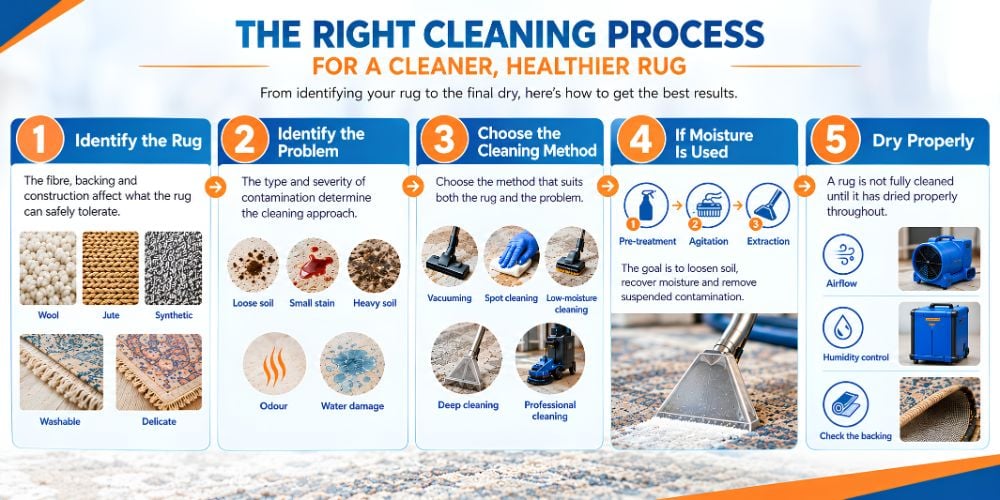
Ask two questions in order: what needs to come out, then what can this rug safely tolerate. Only then pick a method.
Vacuuming
The foundation of routine care. Removes loose soil before it embeds deeper into the fibres. Use a lower suction or no-beater-bar setting on delicate rugs, and vacuum underneath too; soil collects on the floor and migrates back up.
Spot cleaning
For an isolated fresh spill:
- Remove any solid material.
- Blot the spill gently.
- Identify the rug fibre.
- Test the cleaning product on a hidden area.
- Follow the product manufacturer’s recommended dwell time.
- Treat the affected area only.
- Remove any remaining residue where appropriate.
- Dry the area thoroughly.
Hot water extraction
For rugs that tolerate it, a typical professional process runs:
Inspection → vacuuming → pre-treatment → appropriate agitation → extraction → appropriate rinse/recovery → drying → final inspection
A common problem with DIY wet cleaning is that solution can be applied more easily than it can be properly recovered. Without equipment designed for effective moisture recovery, cleaning solution and suspended soil can remain in the pile and backing. This is where carpet extractors become useful for suitable professional cleaning applications.
When Professional Equipment Becomes Useful
For a cleaning business handling rugs regularly, professional extraction equipment becomes useful when the operator needs consistent solution application, effective moisture recovery, and repeatable results across multiple jobs. A portable heated extractor can provide more controlled extraction than typical household equipment, particularly when rugs are cleaned frequently or require deeper cleaning.
How to Deep Clean a Rug at Home
- Check the care label. Follow it instead of relying on a generic method.
- Identify the material.
- Vacuum thoroughly before introducing moisture.
- Test the cleaning solution on an inconspicuous area and follow the product manufacturer’s recommended dwell time.
- Treat stains separately before a full clean. Do not wet the whole rug for one spot.
- Pre-treat where appropriate. The pre-treatment should suit both the rug fibre and the type of soil. Where a specialised approach is needed, rug cleaning products can be more appropriate than a general household cleaner.
- Clean with a method matched to the fibre. Do not simply choose the strongest method available.
- Recover as much moisture as possible.
- Dry with active airflow.
- Inspect once fully dry.
Does Baking Soda Actually Clean Rugs?
It can help with surface odour in a dry application, but it’s not a substitute for soil removal, stain treatment or extraction. It also creates a practical problem: a fine powder pressed into pile is genuinely hard to fully recover with a household vacuum, and leftover residue can attract more soil over time. Match the tool to the actual problem — odour, dry soil, a liquid stain, and grease are four different jobs.
Removing Common Rug Stains
| Stain | Action | Note |
| Coffee/tea | Blot immediately, treat by fibre type | Faster action = less set-in staining |
| Food | Remove solids, treat residue gently | Don’t rub it into the pile |
| Grease | Use an oil-specific treatment | Water alone won’t shift oil-based soil |
| Mud | Let it dry fully, then vacuum before treating | Wet mud smears; dry mud lifts out |
| Pet accidents | Treat surface and check the backing | Odour and liquid often reach below the visible stain |
| Old/unknown stains | Test before treating | Previous treatments may have already altered the fibre or dye |
Why Is My Rug Still Wet After Cleaning?
Usually one of: too much solution applied, insufficient extraction, dense/high pile holding moisture, a moisture-retaining backing, poor airflow, or high ambient humidity. The more useful question isn’t “how long should it take” — it’s “where is the moisture trapped, and what’s stopping it from leaving.”
Drying a Rug Properly (Including for Australian Conditions)
Drying starts before you clean, not after. Plan for it.
- Airflow: Active air movement across the rug surface can help accelerate drying compared with passive drying. A suitable air mover can provide controlled airflow across the rug during the drying stage.
- Humidity: In humid conditions, particularly during warmer and wetter periods, moisture in the surrounding air can slow evaporation even when airflow is strong. A dehumidifier used alongside an air mover can help reduce moisture in the air and support more effective drying.
- Underneath airflow: where practical, lift or prop the rug so air moves underneath too — moisture trapped against a hard floor or trapped by the backing won’t show on the surface but will keep the rug effectively wet.
- Don’t judge by the surface. A dry-feeling pile can still hide moisture in the backing.
When Water Damage Changes the Job
A flooded or contaminated-water-affected rug is a restoration job, not a cleaning job; priority shifts to extraction, air movement, and dehumidification before any cosmetic cleaning. Don’t treat a water-damaged rug like an ordinary stained one.
Common Mistakes
- Using one method on every rug type
- Over-wetting (“more water = cleaner” is false)
- Choosing a chemical before identifying the fibre
- Skipping the spot test
- Ignoring the backing when assessing moisture risk
- Returning a rug to use while still damp underneath
When to Call a Professional
Professional cleaning can be worth considering for valuable or antique rugs, unidentified fibres, significant staining, extensive pet contamination, large rugs, or previous failed cleaning attempts.
Before hiring a cleaner, ask what method they recommend for the specific fibre and how they plan to recover moisture. If you’re a cleaning business looking to bring this work in-house, our commercial extraction equipment range is built for exactly this kind of repeat, controlled use.
Conclusion
Identify the rug. Identify the problem. Match the cleaning method to both. Plan moisture recovery before introducing water, then dry the rug thoroughly from the surface through to the backing.
For occasional home use, regular vacuuming and careful spot treatment may be enough. For cleaning businesses handling higher volumes, consistent results usually depend on controlled solution application, effective extraction, and proper drying support.
FAQs
How can I clean my rug at home by myself?
Identify the material, vacuum thoroughly, test any product on an inconspicuous area first, treat stains separately, and plan moisture recovery and drying before you start.
What is the best way to clean a rug?
There’s no single best method; it depends on fibre, backing, soiling level, and manufacturer instructions.
Can you wash every rug?
No. Some rugs are washable; others can be damaged by excess moisture or agitation. Check the fibre, backing, and manufacturer’s instructions first.
Does baking soda actually clean rugs?
It can help with surface odour but doesn’t replace proper stain treatment or extraction.
How do I clean a wool rug?
Use a wool-appropriate cleaning solution and process, avoid high-alkaline products and excessive heat, and test before treating the whole rug.
How do I clean a jute rug?
Blot spills as soon as possible and avoid soaking; jute absorbs moisture quickly and can wick into the backing.
How long does a rug take to dry after cleaning?
It varies with pile density, backing, and humidity, but active airflow typically speeds drying up substantially compared with passive drying alone.
Why is my rug still wet after cleaning?
Usually excess solution, weak extraction, dense pile, a moisture-holding backing, poor airflow, or high humidity.
Can a rug cleaning machine remove stains?
It can lift soil and many stains, but full removal isn’t guaranteed; it depends on the substance, fibre, dye, and stain age.
